



Industrial CCTV Installation: Complete Guide for Factories & Manufacturing Units | Yendra Techno Solution Yendra Techno Solution share cableINDUSTRIAL CCTV · PILLAR GUIDE Industrial CCTV Installation: Complete Guide for Factories & Manufacturing Units Site survey to handover, cabling and network infrastructure, NVR sizing, common mistakes, and two real factory installations — everything that goes into engineering industrial CCTV properly. schedule18 min read personBy Yendra Team event_repeatUpdated Aug 2026 fact_checkGet a Site Survey listJump to Section Summary What Is It Why It’s Different Installation Process Camera Placement Cabling & Network NVR & Storage Common Mistakes Cost Case Studies FAQs summarizeSummary What This Guide Covers Industrial CCTV installation is a defined engineering process — site survey, camera placement, cabling and network design, NVR sizing, installation, and testing — built for factories, not scaled up from a residential job. check_circleThe 10-step installation process, from site survey to handover check_circleHow to plan camera locations across production, gates, warehouse, and perimeter check_circleCat6, PoE, underground conduit, long cable runs, and surge protection explained check_circleHow NVR capacity and storage duration should actually be sized check_circleThe most common installation mistakes we’re called in to fix check_circleWhat drives installation cost, and where to get a full breakdown check_circleTwo real factory installations — a 32-camera and a 49-camera deployment This guide is the installation-focused deep dive in our factory CCTV resource — for the full commercial overview, see CCTV Surveillance for Factory. helpThe Basics What Is Industrial CCTV Installation? Q. What is industrial CCTV installation?Designing, cabling, mounting, and commissioning a surveillance system across a factory, warehouse, or manufacturing facility — engineered for the site, not scaled up from a residential setup. Industrial CCTV installation is the process of designing, cabling, mounting, and commissioning a surveillance system across a factory, warehouse, or manufacturing facility — as opposed to installing a handful of cameras in a home or a retail unit. The core difference isn’t the cameras themselves. It’s everything around them: cable runs that can stretch past 100 metres, network infrastructure that has to survive industrial electrical noise, recorders sized for 30–50+ channels instead of 4–8, and a physical environment with dust, heat, machinery vibration, and 24-hour operations. Industrial installation has to be engineered for that environment, not just scaled up from a smaller job. boltWhat Sets It Apart Why Industrial CCTV Installation Is Different A few things separate industrial installation from standard commercial or residential work. Q. How is industrial CCTV installation different from a home or office setup?Industrial installation covers far more cameras, longer cable runs, harsher environments, and continuous multi-shift operations — needing engineered infrastructure like PoE switching, underground conduit, and surge protection that residential jobs simply don’t require. 1Scaleexpand_more Factories commonly need 20–50+ cameras across production floors, warehouses, perimeters, and offices — not 4–8 cameras covering a single building. 2Distanceexpand_more Camera-to-NVR distances routinely exceed 100 metres, which changes cabling choices, PoE budgeting, and signal loss planning. 3Environmentexpand_more Dust, heat, vibration from machinery, and outdoor exposure demand IP-rated enclosures and cameras — not standard indoor hardware. 4Continuityexpand_more Many facilities run multiple shifts or operate 24/7, so installation has to be sequenced to avoid disrupting production. 5Infrastructureexpand_more Underground conduit, PoE switching, surge protection, and structured Cat6 networking are standard requirements, not optional upgrades. Skipping any of these considerations is usually where industrial CCTV projects go wrong — not because the cameras were the wrong choice, but because the infrastructure around them wasn’t engineered for the site. checklistThe Process Industrial CCTV Installation Process A properly executed installation follows a defined sequence. Skipping steps is where blind spots and rework come from. 1SITE SURVEY Walk the facility Map the layout, existing infrastructure, power points, and site constraints. 2REQUIREMENTS Security requirements analysis Map what the client needs to see and why, before any camera is chosen. 3PLACEMENT Camera placement Type and position planned area by area, catching blind spots on paper first. 4NETWORK Network planning PoE switch count, placement, and bandwidth sized to camera count and resolution. 5CABLING Cable routing Paths planned to minimise run length and protect cabling from machinery and weather. 6STORAGE NVR/storage planning Channel capacity and storage size calculated, not picked off a shelf. 7INSTALL Installation Cameras, NVR, switches, and cabling installed exactly as planned. 8CONFIGURE Configuration Resolution, motion zones, recording schedule, storage, and remote access set up. 9TEST Testing Every camera and channel checked for image quality, night vision, and retention. 10HANDOVER Handover Client’s team walked through the system, with documentation left behind. verifiedReal Installation Evidence Real Industrial Installation Engineering — Maigma Granite Exports A 32-camera IP surveillance system was deployed at Maigma Granite Exports (Shoolagiri, Tamil Nadu) using Hikvision and Prama cameras with a 32-channel Hikvision NVR and a dual-monitor monitoring wall. The installation included Cat6 cabling with 100m+ cable runs, underground conduit, PoE/PoE+ infrastructure, and surge protection — engineered for a continuous industrial granite manufacturing environment. The system supports 24/7 remote and mobile access. 32-camera deployment 100m+ cable runs 32-channel NVR Dual-monitor wall Remote/mobile access fact_checkGet an Industrial CCTV Site Survey This is how the process works end to end — if you’re ready to book the work itself, see our CCTV Camera Installation for Factory service page. mapPlacement Planning How to Plan CCTV Camera Locations in a Factory Placement isn’t about spreading cameras evenly — it’s about mapping coverage to risk, zone by zone. Zone What It Covers Key Consideration Production Floor Process areas, machine-adjacent activity Angles that avoid machinery or stock blocking the view Entry & Exit Gates Vehicle and personnel movement Positioned for clear identification, not just motion Warehouse & Storage Racking, loading docks, dispatch points Highest inventory risk areas get priority coverage Perimeter & Boundary Compound walls, approach roads Long-range coverage with adequate night vision Offices Administrative areas Lighter coverage, less conspicuous camera type Parking Areas Employee and visitor vehicles Covers both vehicle safety and traffic disputes Server / Control Rooms Restricted-access infrastructure Dedicated coverage — this protects the CCTV system itself The goal is to walk the site with a layout drawing and mark every angle — checking for overlap

Indoor vs Outdoor Wireless CCTV Cameras: Which One Do You Need?
Indoor vs Outdoor Wireless CCTV Cameras: Which One Do You Need? Indoor vs Outdoor Wireless CCTV Cameras: Which One Do You Need? Summary Indoor wireless CCTV cameras are designed for monitoring rooms, hallways, children, elderly family members, and indoor assets. Outdoor wireless CCTV cameras are built to handle rain, dust, sunlight, and temperature changes. Weatherproof wireless cameras require appropriate IP ratings for long-term reliability. WiFi coverage is often the biggest challenge in wireless CCTV installations. Apartments typically require more indoor coverage than outdoor coverage. Villas require a combination of indoor and outdoor surveillance. Offices benefit from separate indoor and perimeter security monitoring. Choosing the correct camera type improves performance, image quality, and camera lifespan. Introduction Wireless CCTV cameras have become one of the most popular security solutions for homeowners, apartment residents, villa owners, offices, and businesses across Bangalore. Offering flexible installation, remote monitoring, smartphone alerts, and AI-powered security features, wireless surveillance systems provide a convenient way to protect people, property, and assets without extensive cabling. However, choosing the right camera type is just as important as choosing the right brand. Many buyers struggle to decide between an indoor wireless CCTV camera and an outdoor wireless CCTV camera, often assuming they serve the same purpose. In reality, each is designed for a specific environment. While an indoor wireless CCTV camera is optimized for monitoring rooms, hallways, offices, and living spaces, an outdoor wireless CCTV camera is built to withstand Bangalore’s rain, dust, heat, humidity, and changing weather conditions. Selecting the wrong camera can lead to poor performance, connectivity issues, reduced lifespan, and security blind spots. Understanding the differences between indoor wireless CCTV, outdoor wireless CCTV, and weatherproof wireless camera solutions will help you choose the right surveillance system for your apartment, villa, office, or commercial property. In this guide, we’ll compare their features, installation requirements, WiFi challenges, weather protection standards, and ideal use cases so you can make an informed security decision. 1. What Is an Outdoor Wireless CCTV Camera? Q: What is an outdoor wireless CCTV camera? An outdoor wireless CCTV camera is a weatherproof security camera that transmits video over WiFi while being designed to withstand rain, dust, heat, and outdoor environmental conditions. Most outdoor wireless CCTV cameras include night vision, motion detection, and IP65 or IP66 weather protection. An outdoor wireless CCTV camera is engineered to withstand harsh environmental conditions while continuously monitoring the perimeter of a property. These cameras are commonly installed at: Main gates Parking areas Driveways Compound walls Entry points Rooftops Loading bays Commercial entrances Benefits of Outdoor Wireless CCTV Early threat detection Property perimeter protection Vehicle monitoring Visitor tracking Intruder detection AI-based motion analytics Outdoor cameras serve as the first line of defense by detecting suspicious activity before someone enters the building. 2. What Is an Indoor Wireless CCTV Camera? Q: What is an indoor wireless CCTV camera? An indoor wireless CCTV camera is a WiFi-enabled surveillance camera designed for monitoring rooms, hallways, offices, children, pets, and elderly family members inside buildings. Indoor wireless CCTV cameras are compact, easy to install, and optimized for controlled indoor environments. An indoor wireless CCTV camera is designed specifically for enclosed spaces where environmental conditions are stable. These cameras connect through WiFi and are commonly installed in: Living rooms Hallways Children’s rooms Elderly care monitoring areas Home offices Retail stores Reception areas Small office workspaces 3. Indoor Wireless CCTV vs Outdoor Wireless CCTV Q: What is the difference between indoor wireless CCTV and outdoor wireless CCTV? The main difference is durability and environmental protection. Indoor wireless CCTV cameras are designed for enclosed spaces, while outdoor wireless CCTV cameras are weatherproof, dust-resistant, and built to handle rain, sunlight, and temperature changes. Q: Can an indoor wireless CCTV camera be used outdoors? No. Indoor wireless CCTV cameras lack weatherproof protection and can be damaged by rain, dust, humidity, and direct sunlight when installed outdoors. Feature Indoor Wireless CCTV Outdoor Wireless CCTV Installation Location Inside rooms and buildings Outside property Weather Resistance Not required Essential Size Compact Larger and rugged Night Vision Standard Enhanced IR or Color Night Vision Durability Moderate High Dust Protection Limited High Rain Protection None Required Price Lower Higher Primary Purpose Activity monitoring Intrusion prevention 4. WiFi Challenges in Wireless CCTV Installations Q: Why does my outdoor wireless CCTV camera keep disconnecting? Outdoor wireless CCTV cameras often disconnect due to weak WiFi signals, long distances from the router, concrete walls, metal structures, network congestion, or insufficient bandwidth. Q: How can I improve WiFi performance for wireless CCTV cameras? Improve wireless CCTV performance by using mesh WiFi systems, WiFi extenders, dual-band routers, strategic router placement, and dedicated security camera network configurations. Weak Signal Strength Signals weaken when passing through: Concrete walls Granite structures Metal gates Staircases Water tanks Network Congestion Modern homes often have: Smartphones Smart TVs Alexa devices Laptops IoT devices All competing for WiFi bandwidth. Distance Issues Outdoor cameras installed at: Gates Parking areas Boundary walls may be too far from the router. How to Improve Wireless CCTV Performance Install mesh WiFi systems Use dual-band routers Add WiFi extenders Position routers centrally Use dedicated CCTV network segments For larger properties, you may find that a hybrid system works better than a fully wireless setup. Read our detailed comparison of Wired vs Wireless CCTV Cameras to understand which architecture suits your property best. 5.Weather Exposure: Why Outdoor Wireless CCTV Cameras Need Special Protection Q: Do outdoor wireless CCTV cameras need weatherproof protection? Yes. Outdoor wireless CCTV cameras require weatherproof housing to protect against rain, dust, humidity, heat, and UV exposure. Without proper protection, camera performance and lifespan can be significantly reduced. Q: Can rain damage an outdoor wireless CCTV camera? Properly rated weatherproof wireless cameras can operate safely in heavy rain. Cameras without adequate IP ratings may experience water ingress and hardware failure. Bangalore experiences: Heavy monsoon rainfall High UV exposure Dust accumulation Humidity fluctuations Temperature changes A standard indoor wireless camera exposed outdoors can fail within months. Common failures include: Lens fogging Water ingress Corrosion
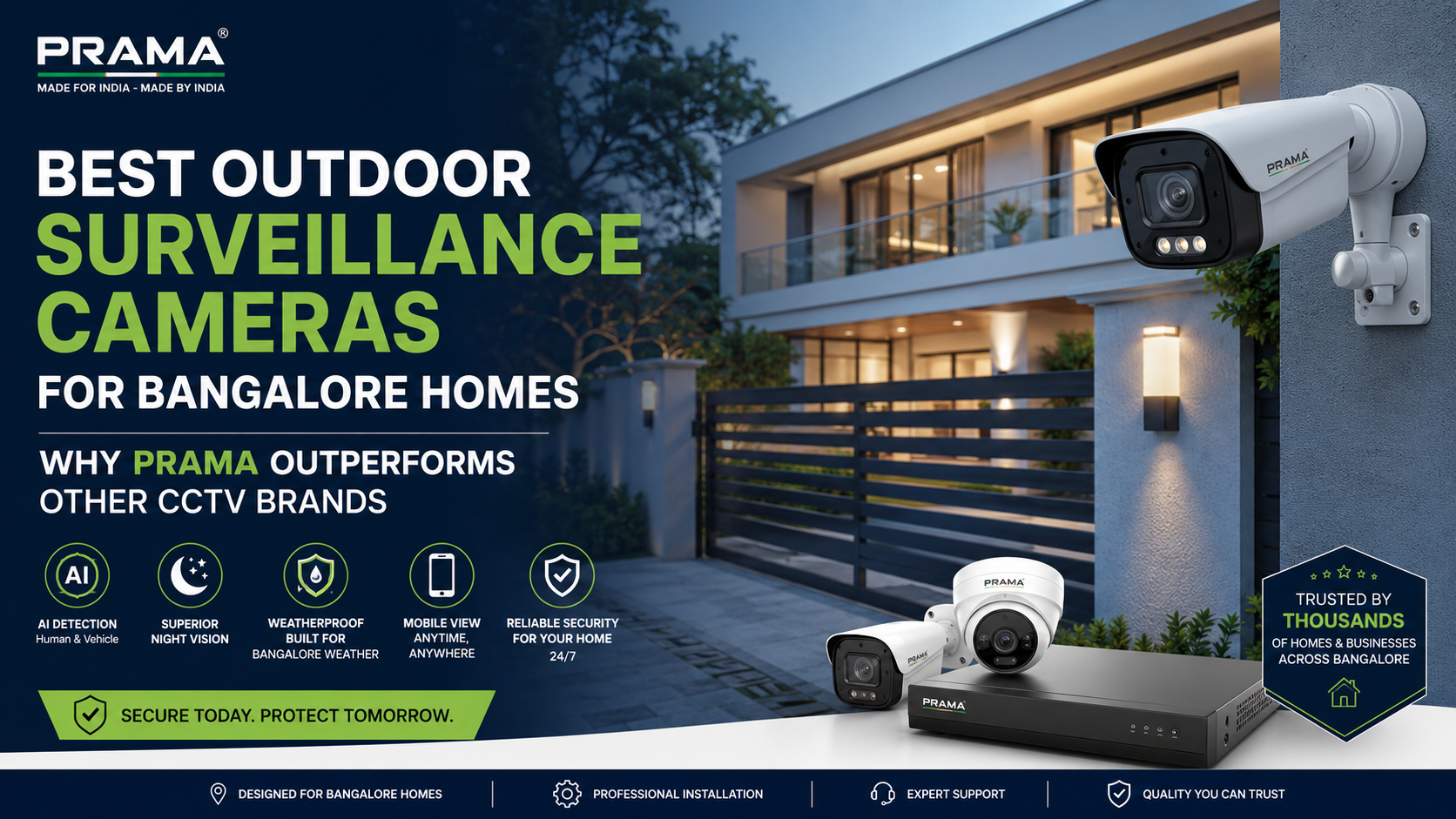
Best Outdoor Surveillance Cameras for Bangalore Homes: Why Prama Outperforms Other CCTV Brands
Best Outdoor Surveillance cameras for bangalore Honmes: Prama Ouperforms other CCTV brands Best Outdoor Surveillance Cameras for Bangalore Homes: Why Prama Outperforms Other CCTV Brands What is CCTV installation in Bangalore? CCTV installation in Bangalore is the process of designing, selecting, and installing surveillance cameras with proper networking, storage, and monitoring systems. A professional installation ensures clear video footage, reliable performance, and compliance with government standards like STQC certification. Summary Outdoor surveillance cameras must be selected based on Bangalore weather, lighting conditions, and property layout. Cheap CCTV systems often fail in outdoor environments due to poor weatherproofing and weak night vision. Prama cameras offer better AI detection, image clarity, durability, and long-term reliability. Professional installation matters as much as the camera brand. Villas, apartments, and independent homes require different surveillance strategies. AI-enabled outdoor cameras reduce false alerts and improve real-time security response. Proper outdoor surveillance planning can later scale into factory, warehouse, and industrial security systems. 1. Introduction: Why To Compare Between CP Plus vs Prama CCTV? CP Plus vs Prama CCTV comparison helps buyers choose the right security camera system based on performance, durability, and surveillance intelligence. While CP Plus is popular for budget CCTV setups, Prama offers advanced AI-powered video surveillance systems ideal for homes, offices, and factories in Bangalore. Outdoor security is no longer optional for Bangalore homes. Whether you live in a villa in Sarjapur Road, an apartment in Whitefield, or an independent house in North Bangalore, the demand for reliable outdoor surveillance cameras has increased rapidly in recent years. From vehicle theft and parcel theft to unauthorized access and perimeter monitoring, homeowners now expect more than just basic recording. They want smarter detection, reliable night visibility, weather-resistant performance, mobile monitoring, and professional installation support. However, one major challenge remains:Most homeowners choose CCTV systems based only on price. That often leads to: poor night footage camera failures during rain storage issues false motion alerts unreliable mobile access poor installation quality lack of long-term support This is where professional-grade surveillance brands like Prama stand apart. In this guide, we explain why Prama outdoor surveillance cameras are becoming the preferred choice for Bangalore homeowners — and how professional CCTV planning by Yendra helps create long-term security instead of temporary fixes. 2.Why Outdoor Surveillance Cameras Matter More in Bangalore? Why To Compare Between CP Plus vs Prama CCTV? CP Plus vs Prama CCTV comparison helps buyers choose the right security camera system based on performance, durability, and surveillance intelligence. While CP Plus is popular for budget CCTV setups, Prama offers advanced AI-powered video surveillance systems ideal for homes, offices, and factories in Bangalore. Bangalore has seen rapid expansion in: gated communities villa developments peripheral residential layouts independent houses under-construction residential zones Many areas experience: low-lit streets isolated parking zones limited security manpower blind spots around properties As a result, homeowners are increasingly searching for: best outdoor security cameras security cameras for outside home house surveillance cameras home security camera system AI CCTV for villas Modern outdoor surveillance cameras are now expected to provide: 24/7 monitoring clear night vision AI motion detection mobile app alerts perimeter protection remote access For Bangalore homes, outdoor surveillance is often the first and most important security layer. 3. Common Problems with Cheap Outdoor CCTV Systems What is CP Plus vs Prama CCTV? CP Plus is known for affordable entry-level CCTV systems, while Prama focuses on enterprise-grade surveillance solutions with AI-powered monitoring, better reliability, and industrial security applications. Prama is often preferred for long-term security infrastructure in India. Many homeowners initially choose low-cost cameras from local resellers or online marketplaces. While the upfront pricing may appear attractive, the long-term performance is usually disappointing 1. Poor Night Vision Performance Outdoor areas in Bangalore often have uneven lighting. Cheap cameras struggle with: glare from vehicle headlights overexposed entrances dark perimeter walls low-light parking areas This results in unclear footage exactly when incidents happen. 2. Weak Weather Resistance Outdoor cameras face: heavy monsoon rain dust accumulation humidity heat exposure Low-quality cameras may fail within months due to: water seepage fogged lenses overheating cable damage Professional-grade outdoor surveillance cameras must have proper IP-rated weather protection. 3. Frequent False Alerts Traditional motion detection triggers alerts for: moving trees animals rain movement light changes This creates alert fatigue, causing homeowners to ignore notifications. Modern AI-enabled surveillance systems reduce false alarms significantly. 4. Low Image Clarity Many low-cost systems still use outdated resolutions. In real incidents, homeowners discover: faces are unclear vehicle numbers are unreadable footage becomes pixelated during zoom High-resolution AI cameras provide far better evidence quality 5. No Proper Surveillance Planning A major issue is improper camera placement. Common mistakes include: blind spots near gates poor angle coverage incorrect height insufficient perimeter visibility A good CCTV system is not just about cameras — it is about surveillance architecture. 4.Why Prama Outdoor Surveillance Cameras Perform Better What is CP Plus vs Prama CCTV? CP Plus is known for affordable entry-level CCTV systems, while Prama focuses on enterprise-grade surveillance solutions with AI-powered monitoring, better reliability, and industrial security applications. Prama is often preferred for long-term security infrastructure in India. Prama has emerged as a strong professional surveillance brand for residential and commercial applications across India. For Bangalore homeowners, Prama offers a balance of: image quality AI features durability reliability professional ecosystem support Here’s why Prama stands out. 1. Better AI Detection for Real Outdoor Security Modern Prama outdoor surveillance cameras support AI-powered analytics such as: human detection vehicle detection intrusion alerts perimeter protection This helps reduce unnecessary alerts while improving real-time monitoring. For villas and independent homes, AI analytics become especially valuable during night hours. 2. Superior Night Vision Quality Outdoor incidents often happen in low-light conditions. Prama cameras offer: enhanced infrared visibility color night vision options wide dynamic range improved low-light imaging This ensures better facial visibility and vehicle identification. 3. Weather-Ready for Bangalore Conditions Prama outdoor cameras are designed for harsh outdoor conditions with: IP-rated weatherproofing durable housing heat resistance stable outdoor operation This is critical for long-term reliability

Which Outdoor CCTV Camera Is Best for Villas in Bangalore? The 2025 STQC-Secure Homeowner’s Guide
Outdoor CCTV camera Which Outdoor CCTV Camera Is Best for Villas in Bangalore? The 2025 STQC-Secure Homeowner’s Guide Summary The best Outdoor CCTV camera for Bangalore villas must be STQC-certified, weatherproof (IP66+), and tamper-resistant. Top recommended brands: Prama Hikvision (Made in India) and CP Plus with STQC certification. Place cameras at the crtical entry & exit points, parking, garden, backyard, perimeter, easy access zones, terraces, electrical/machine rooms & pathways Avoid WiFi-only models for villas — use wired + secure NVR setup. Ask installers to encrypt your system, change admin passwords, and secure remote access. Yendra Techno Solution provides STQC-certified outdoor CCTV installation with in-house technicians (no freelancers). Introduction: Why Outdoor CCTV Cameras Matter More for Bangalore Villas in 2025 Villas in Bangalore—especially in Whitefield, Sarjapur Road, Yelahanka, Kengeri, Hennur, Devanahalli, and Electronic City—face increasing security needs due to: Low foot traffic around gated communities Frequent parcel deliveries Unmonitored perimeters Larger outdoor open spaces More entry/exit points An Outdoor CCTV camera is the first line of defence for villa security, but not all outdoor cameras are secure. Many non-certified models send data to foreign servers or have weak cyber protection. This is why STQC-certified Outdoor CCTV cameras are the new gold standard for villa security in India. You can read our complete buyer’s guide: best CCTV camera for home in Bangalore to know more in details about CCTV camera selection options. Right now let’s dive into the speciific guide for Villa. What Makes an Outdoor CCTV Camera Different from Indoor Models? Outdoor cameras are exposed to harsh conditions, so they require stronger build, better visibility, and higher durability. Key differences: Feature Outdoor CCTV Camera Indoor Camera Weather resistance IP66/IP67 None Tamper protection Metal body Plastic body Night vision EXIR IR / ColorVu Basic IR Range 30m–120m 10–15m Power options Wired/POE WiFi STQC availability Yes Limited If you want to know more about indoor vs outdoor CCTV camera applications, You can read our article: Indoor vs Outdoor Wireless CCTV Cameras: Which One Do You Need? 👉 For villas, always choose an STQC-certified Outdoor CCTV camera instead of indoor-grade WiFi models. Why STQC Certification Matters for Outdoor CCTV Cameras in Bangalore An outdoor camera faces greater cyber risk because it’s often connected to WiFi or accessible from outside networks. STQC Certification Guarantees Tamper-proof encrypted firmware No foreign data routing Secure mobile app authentication Government-approved security protocols No backdoor access for hackers Strong anti-hijacking features This is crucial for villa installations because outdoor cameras monitor: Family movements Car parking Entry gates Staff entry Children’s play areas 👉 Your outdoor CCTV must protect your privacy—not expose it. Types of Outdoor CCTV Cameras for Villas Different villas require different camera types based on coverage area, distance, and angle. 1. Bullet CCTV Camera (Most Common) Best for walls, gates, and perimeter lines. Ideal for: Long driveways Entry/exit gates Compound walls Advantages: Long-range lenses Weatherproof Highly visible (acts as deterrent) 2. Turret CCTV Camera (Most Versatile) Compact and ideal for entrances and sideways. Advantages: Low-light visibility Anti-glare Sleek design for villas 3. PTZ CCTV Camera (Premium Villas) PTZ = Pan, Tilt, Zoom. Best for: Large villas Multi-acre properties High boundary walls Advantages: Covers 360° Zooms up to 30x Tracks movement 4. Color-at-Night CCTV Camera Brand variants include: Hikvision ColorVu CP Plus Color Pro Advantages: Full-color recording even at night No blind spots High clarity footage Recommended STQC-Certified Outdoor CCTV Camera Models Below are trusted, India-compliant brands offering STQC-certified outdoor models. 1. Prama Hikvision India Pvt Ltd Indian manufacturing Certified firmware Strong night vision Best for large villas STQC approved models in all categories 2. CP Plus – Aditya Infotech India Pvt Ltd India’s leading consumer security brand Durable outdoor cameras Anti-vandal dome models STQC certified with secure app ecosystem For More insight, read our articles: Best Outdoor Surveillance Cameras for Bangalore Homes: Why Prama Outperforms Other CCTV Brands CP Plus vs Prama CCTV: 11 Key Differences That Decide the Best Security Camera in Bangalore (2026 Expert Guide) Where Should You Install Outdoor CCTV Cameras in a Villa? Outdoor cameras must cover all external entry points. Essential Outdoor CCTV Camera Placement Map Must-Have Locations for Every Villa: Main Gate Front Door Backyard Parking / Carport Perimeter Walls Terrace Access Points Side Pathways Pro Tip: Camera Height Install each Outdoor CCTV camera at 9–12 feet height to avoid tampering and maintain clarity. Know how to choose the right CCTV lens Pro Tip: Avoid Blind Spots Use this quick table: Area Camera Type Lens Notes Main Gate Bullet/ColorVu 2.8mm Plate capture Parking Turret 4mm Wide view Backyard Bullet 3.6mm Long-range Terrace Dome 2.8mm Anti-weather Perimeter Bullet/PTZ 6mm Line-crossing alerts Wired vs Wireless CCTV Cameras for Villas in Bangalore Most villa owners ask: “Should I install a WiFi Outdoor CCTV camera or a wired one?” Here’s the answer: Wired CCTV Camera (Recommended) Stable Secure No hacking from WiFi Clear resolution Best for: Permanent installations Wireless CCTV Camera Easy to install✘ Weaker security✘ WiFi drops affect footage✘ Higher hacking risk unless STQC-certified Best for: Temporary setups For Comprehensive understanding, Further read: Wired vs Wireless CCTV Camera: Which is Better for Bangalore Homes & Businesses? For villas, always choose wired models + STQC certification. Important Features to Look for in Outdoor CCTV Cameras Before buying any Outdoor CCTV camera, check these: 1. STQC Certification Mandatory for cyber safety.Protects from foreign data access. 2. Weatherproof Rating (IP66/IP67) Outdoor cameras must handle: Rain Heat Dust Monsoon humidity 3. IR or Color Night Vision Full-color night footage is ideal for villas. 4. Edge AI Features Human detection Vehicle alerts Line-crossing detection Intrusion monitoring 5. Secure Mobile App Access Avoid apps requiring foreign cloud access. 6. Metal Casing Protects from outdoor handling and vandalism. How to Choose an Outdoor CCTV Camera for Your Villa (Checklist) Use this villa owner’s checklist: ✔ YES — Essential Requirements STQC-certified Outdoor CCTV camera Wired or POE connection Encryption-enabled NVR Secure installation (no default passwords) IP66/IP67 rating UPS backup Internal NVR placement ❌ NO — Avoid These Mistakes Cheap WiFi cameras Non-certified